
The ancient city of Aptera, Greece
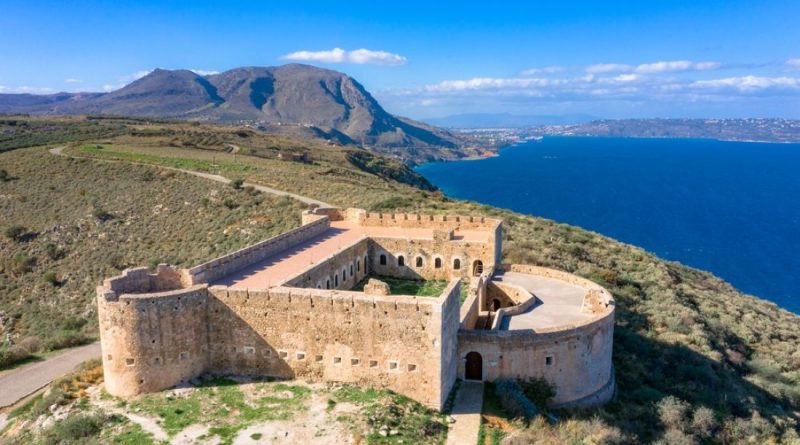
Above the entrance to the great harbour of Souda, where Paleokastro stands today near the village of Megala Chorafia, the extensive ruins of the ancient city of Aptera (also referred to as Apteria, Apterea, or Aptaria) can be found. The name Aptera, according to one tradition, derives from Apteron, king of Crete, son of Kydon and father of Lappios, who is said to have lived in the time of Moses around 1800 BC. The legend of Apteron lends itself to the suggestion that the city was once a colonial settlement governed by the Dorian Apteros or Aptaros who took part in the occupation of Crete towards the end of the Minoan era.
Alternative legends claim the city of Aptera took its name following a musical competition between the Muses and the Sirens held in the Temple of the Muses. At the time of the competition the city, which was to become Aptera, was renowned as a centre far musical expertise.
The Muses emerged as victors of the competition, a defeat which left the Sirens in such a distressed state that their feathers fell out into the sea, where they were transformed into the small ‘white islands’ in Souda Bay. It is from this legend that the city takes its name, Aptera meaning wingless.
The builder of Aptera is believed to have been Glaukos. Archaeological digs in the ancient city by Wescher in 1862-64 unearthed inscriptions confirming the position of Aptera on the site of Paleokastro – Megala Chorafia. Further archaeological digs were undertaken in 1942 involving, amongst others, the Italian archaeologists Mariani and Savignoni.
The city walls of Aptera are made of large polygonal stones to the east and long rectangular ones to the west. The foundations of several large buildings have also been uncovered. Where the church of St. John now stands, once stood the Temple of the Muses. Nearby stood the offices of the college of the government of the time of which a whole wall of inscriptions has been preserved.
A short distance away the remains of the Temple of Eileithnia, the birth goddess, are located. Moreover, following a dig in the 1958, the remains of the Dorian Temple were discovered, close to the preserved ruins of the ancient theatre. There are also the ruins of the double sanctuary or treasure house. Both were wonderfully constructed with interior archways, similar to the ruins of Rome. Smaller finds range from engravings, inscriptions, coins, and drinking vessels to the more elaborate works of art from the Hellenic, Greek and Roman periods. Multi-coloured finger paintings of the greatest beauty and delicacy, representing Apollo and Artemis, have also been found.
The archaeologist Alexiou, during his excavation in 1958, discovered a temple dedicated to Demetrer. In the temple various examples of kerni were discovered dating back to Hellenic times. A kerni was a vessel with many openings in which seeds were placed in the honour of the goddess of agriculture. Alexiou also discovered a group of tombs from the 4th century BC which contained silver brooches, coins and vessels of various kinds. One of his greatest finds was part of a treaty made between Aptera and Kydonia.
The jurisdiction of the city state as a whole ranged from the plain of Apokoronou, towards Kydonia and approximately as far as the plain of Chania, incorporating Akrotiri and the small islands of Souda. Archaeologists estimate the population of Aptera to have been upward of 20,000, of which one-fifth were freemen with the rest of the population in the bonds of slavery.
Many of the freemen were merchants, great landowners or ship owners. Aptera was one of the few cities which had a substantial trading network. This included the most important Mediterranean and Greek ports which allowed Aptera to protect her business interests. The two main ports of the ancient city were Kisamos in Kalives and Minoa, believed to be situated at Marathi on the Akrotiri.
Towards the end of the Minoan age, Aptera was at the peak of its development. This belief is supported by the formidable, large stone cyclopean city walls which protected the ancient city. Defence was a major concern of the Apterians, as traditionally they had fierce and powerful enemies in the Lappians, the people of Lappos. (Today the Argyroypolis in Rethimno).
Lappos had an excellent mercenary army of highly skilled archers whose part in the Messenian war at the end of the 6th century BC is chronicled in history books. However the character of the Apterians differed greatly from their enemies’ military predisposition. The Apterians were primarily a trading nation, noted more for their passivity than aggression.
A steady alliance always existed between the Apterians and the Kydonians. They also had allies in the shape of the Knossians. However, in 210BC, sieges by the Lappians and the Polyrrinians forced them to abandon their alliance. In 183 BC the Apterians became party to the treaty of King Eumenes of Asia Minor. In order to publicise their uncharacteristic aggression the Apterians had the figure of an armed soldier engraved on their coins, which was symbolic of the strength of their mercenary army.
Alternatively the Apterians would, if circumstances permitted, participate in wars without bloodshed. An example of bloodless war would follow along the lines of a conference between the two opposing armies, whilst the Generals assessed the strength of the enemy, the priests would study the omens and accordingly a compromise would be reached.
In this way the attachment of the Apterians to the Kydonian army against the Polyrrinians involved no sacrifice on their part, and worked out to be very advantageous. Moreover, the Apterians did not fight against the Romans, surrendering similarly like the Kydonians who were overwhelmed by Metellus in 63 BC. This placed them in Roman favour which was reflected in the negligible taxes they had to pay.
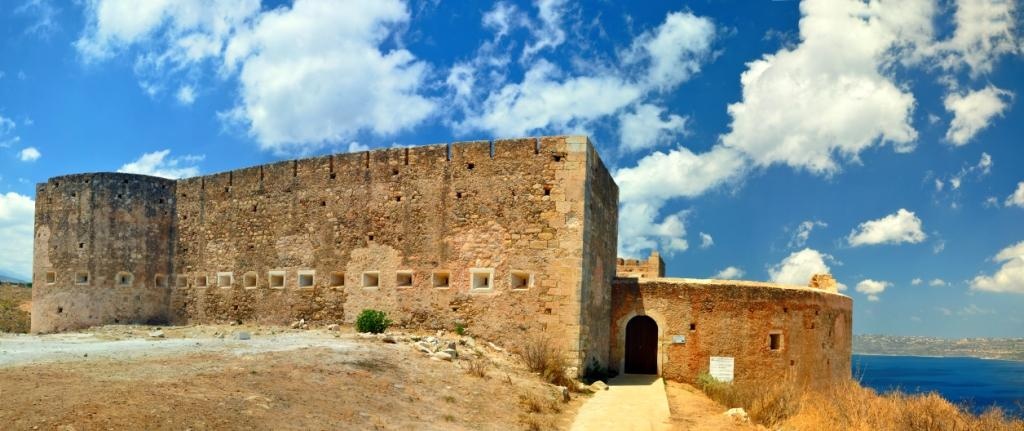
The life of Aptera continued into the Greco-Roman period and into early Christian times, when there was a Bishop of Aptera. Unfortunately, due to later periods of war and natural devastation, the ancient city of Aptera was destroyed. Later on the site of the ancient city, appeared the small settlement of Paleokastro, which was to be destroyed by barbarism in 1583. In the mid-nineteenth century a large proportion of the material ruins of Aptera were aquired by by Reoulf Pasha and utilised in the building of the Itzedin the fortless of Kalami, in honour of the son of the Sultan of the time.
Successive digs have also unearthed limekilns in which the art and the brilliance of the statues of Aptera were turned into lime. Aptera was known as the ‘Gallery of Crete’ and over the centuries was witness to the flowing and ebbing of all the civilisations that have existed in Greece.
The myth of the Muses and the Sirens was followed by the white Dorian eagle, then the black eagle of the Romans, the Saracen hawk, the crows of Barbarossa, the winged lion of Venice and the Islamic stock, until the cycle finished with the German eagle which for a short while rooted its talons in the city of the Muses.
The coins of Aptera were silver with the head of Zeus or a woman on one side and an armed soldier on the other. On some of them is written the word PYTHOAG, on others appear the head of Hermes or Apollo, while on the other side circling the figure of an archer are the words, VICTORY TO APTERA.
The museum of Istanbul contains a host of discoveries from Aptera. Amongst the treasures there are gilt statues of Roman Emperors, many of which are headless due to the frequent change of leadership in the Roman Empire. With each change of emperor the head of the statue would be replaced, just as today we change street names.
The space inside the city walls of Aptera was so vast that it is hard to imagine the enormous scale of the city. From the sheer size of the city it is obvious that in times of war, the walled city was used as a refuge by farmers and other citizens living outside the city walls. It was also a religious and administrative centre as well as a place for celebrations and social gatherings.
Furthermore all of those who have made a study of Aptera confirm that it was one of the great commercial and shipping centres of Crete, mostly due to its favourable location near the harbour of Souda. Aptera was also an industrial city as together with fine finger paintings both iron and bronze forges were discovered very close to the ancient mine of Verekinthos (today Malaxa), the oldest mine in Europe.
The position of the ancient Aptera is one of the most impressive in Crete, situated high on a level plateau with a fantastic panoramic view. In all directions there is rare beauty to meet the eye, the Cretan sea, the valley of Apokoronou which is exceptionally beautiful, the Akrotiri, the high White Mountains and Malaxa are all to be seen.
Pingback: The ancient city of Aptera, Greece photo on Sunsurfer